


Leadership is often sold as a role of action. But for senior leaders and founders, the real job is often absorption.
You become the shock absorber. You stand between the chaos of the market (or the board, or the runway) and the focus of the team. You dampen the noise. You smooth out the bumps so everyone else can keep driving.
This feels necessary. If you crack, the system unravels. So you swallow the doubt, the interpersonal friction, and the strategic terror. You choose silence over disruption.
But physics is clear: energy doesn’t disappear. It has to go somewhere.
When a leader absorbs too much and says too little, that energy settles in the body. It manifests not as a dramatic explosion, but as a quiet, creeping erosion of the self.
The Mechanic of Over-Functioning
In many organizations, this becomes a reflex.
You absorb the tension of a missed quarter so the sales team stays motivated. You absorb the toxicity of a difficult high-performer so the juniors don’t quit. You absorb the uncertainty of a reorg so the engineers can ship.
You tell yourself this is the job. And it is. But the cost is rarely discussed in candid terms.
The cost isn’t just “stress.” The cost is that you start to disappear.
When you habitually say too little, a part of you shrinks away; the part that questions, that doubts, that needs connection. You stop being a person and start being a function. You become a piece of infrastructure; necessary, load-bearing, and invisible.
The Tells
You might think you are hiding this well. But the shock absorber eventually starts to creak. The cost of over-containment shows up in small, specific behaviors:
The Numb Nod: You find yourself nodding along in meetings, agreeing to things you fundamentally question, just to avoid the energy cost of a debate.
The Check-Engine Light: You delay rest, ignore the tightness in your chest, and push through fatigue, treating your body like a rental car you don’t plan to keep.
The Harmony Trap: You start prioritizing “peace” over truth. You let a mediocre decision slide because you don’t have the emotional bandwidth to fight it.
The Isolation Loop: You stop sharing the real problems with your peers or partners because “they wouldn’t get it” or “they have enough on their plates.”
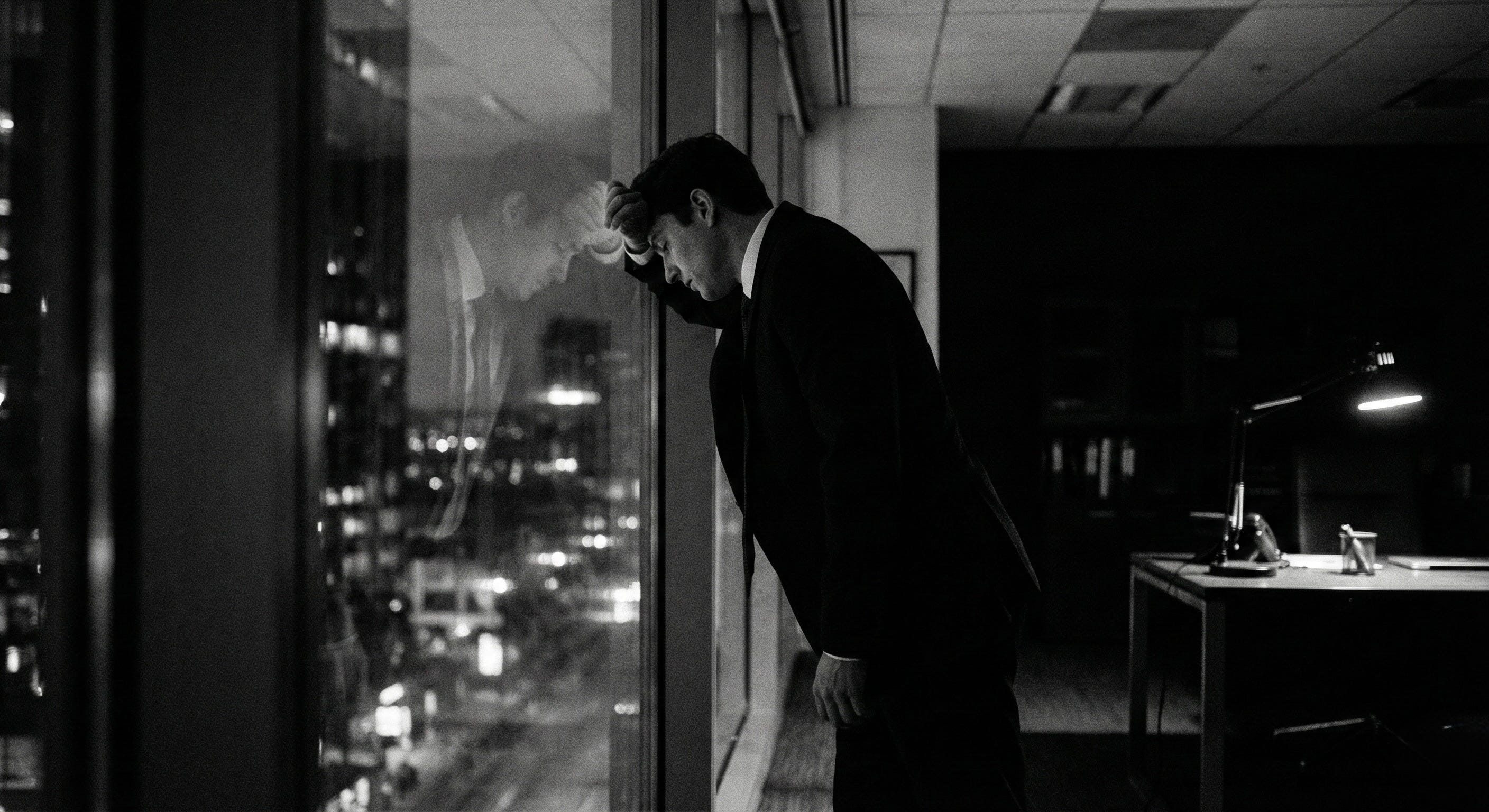
The Quiet Erosion
This is not about burnout. Burnout is loud; burnout stops you in your tracks.
This is moral and emotional injury. It is the slow accumulation of things unsaid.
The tragedy of the “shock absorber” leader is that the better you are at it, the more isolated you become. The more you protect the team from reality, the less they understand the weight you are carrying. You create a reality distortion field where everyone feels safe, and you feel utterly alone.
You are surrounded by people, yet you are the only one who knows the house is shaking.
The Unresolved Weight
There is no “5-step hack” to fix this. You cannot simply “stop absorbing” if you are the CEO or the VP. The weight is part of the seat.
But we need to stop pretending this is heroic. It isn’t resilience. It’s depletion.
If you are carrying the load for everyone else, ask yourself one question today, not as a leader, but as a human:
What is the one thing you are holding back that is actually making you sick?
You don’t have to fix it today. You don’t even have to say it out loud to the team. But for your own sake, you need to acknowledge that the weight is there.
Because eventually, even steel snaps.
Resources
Managed Heart: Commercialization of Human Feeling – Arlie Hochschild’s foundational work on “emotional labor”—the cost of managing feelings to keep others comfortable.
The Loneliness of the Authority Role – A classic HBR perspective on why isolation is a structural feature of leadership, not a personal failing.
Burnout vs. Moral Injury – While written for physicians, this concept perfectly maps to leaders who are forced to absorb systemic dysfunction.