

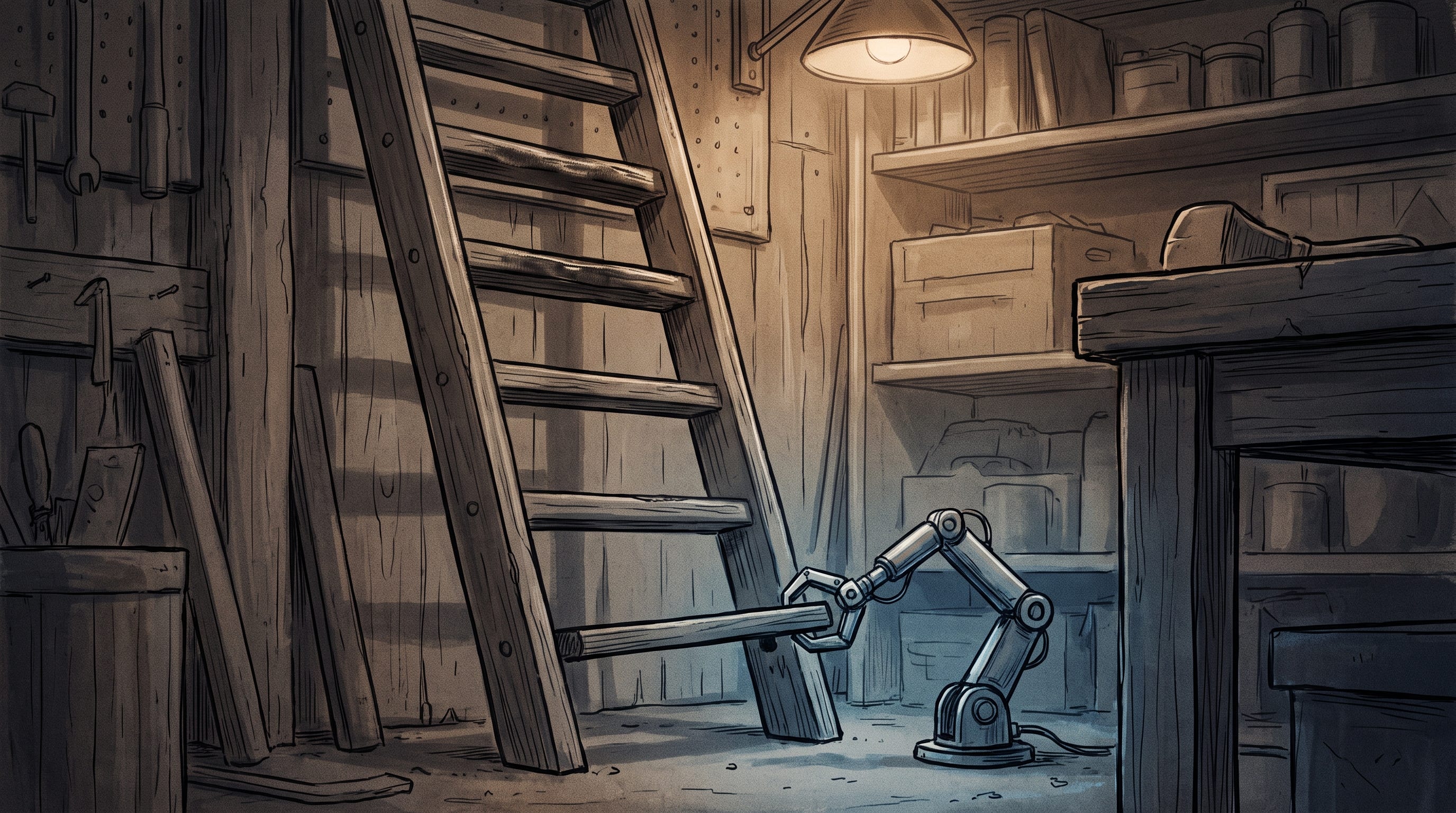
If AI does the entry-level work, where do the senior people come from? The question has nagged me for weeks and I can’t shake it.
I’ve watched people get good, and it never happened the way the org chart says it should. It happened in the boring work, the stuff nobody puts on a highlight reel. Someone burns two days chasing a false lead. Feels like pure waste at the time. But they never get fooled by that pattern again. Next time it shows up, they clock it in seconds and keep that instinct for good. Nobody sat them down and taught it. The two wasted days did.
The grunt work wasn’t in the way of the learning. The grunt work was the learning. Boring on the surface, load-bearing underneath.
And that boring work is exactly what the machines are good at now. So everyone tells a happy story: we’ve freed the junior people from the drudgery, they can skip ahead to the interesting problems. I keep nodding at that story and then not believing it. We’re automating the tuition and keeping the diploma, and the bill arrives late, from a direction nobody’s watching.
Trace it forward and it goes somewhere uncomfortable. If the entry-level work is what generates the reps, and the machines are now eating the entry-level work, then the reps stop happening. No reps, no pattern library. No pattern library, no instinct we’d call senior. Not slower. Missing. And an absence is a hard thing to notice. You don’t miss the people who never got trained, right up until the day you reach for the next person up and your hand closes on air.
The comfortable answer shows up fast, and you may have heard it in a budget meeting. We’ll just hire senior when we need it. Let the machines run the junior tier and buy the experience on the open market.
But every company running that plan is pulling from the same crop, and not one of them is planting next year’s. Senior talent isn’t mined, it’s grown, and the growing is the exact thing we handed to a model. Push it all the way out and it eats itself: harvest every season and plant none, and the field goes bare on a schedule you could almost date. A company that spends its seniors faster than it grows them is eating its seed corn. You can do that for one hard winter. You can’t call it a strategy, though people will, because on a spreadsheet it looks like one.
(The early signals lean the same way, and I hold them loosely: entry-level postings are down about a third in eighteen months, and the 2026 forecasts read it as the agents taking the first rung.)
And I’d be telling half the story if I stopped at the bottom rung. The top is getting cut too. I’ve spent a career becoming the kind of seasoned security person this argument says will be scarce, and the market isn’t acting scarce. It’s acting the opposite. Companies aren’t only skipping next year’s planting. They’re thinning the standing crop, and they’ve learned to be polite about it. In April 2026 Microsoft offered its first voluntary retirement in 51 years: buyouts for its longer-tenured people, the eligibility math literally your age plus your years of service totaling seventy or more, against the backdrop of its roughly $80 billion in AI-infrastructure spending. Voluntary is a generous word for it. My read is extraction at the senior end, dressed so it doesn’t land on the layoff line.
I’ve wanted to be wrong about this, because I don’t love being the guy at the funeral. There’s one clean escape, and it’s a good one. Maybe AI doesn’t only do the junior work. Maybe it hands a beginner senior judgment directly and skips the apprenticeship. I just don’t think it’s the world we’re in…yet. A model can hand you the answer. It can’t hand you the years of being wrong that taught you to hear when an answer is off. It’s like an ear for a mix: you can’t download one. You train it over a few hundred hours, most of them spent on things that turn out not to matter, until you hear the problem before you can name it. Judgment isn’t information. It’s the residue of paying for your own mistakes, and the receipt doesn’t transfer to someone who never paid.
So it comes down to two doors. Either the machine grows senior judgment for us, or it still has to grow inside a person. The first door only opens if judgment can be handed over whole, and it can’t. Which leaves the second. We didn’t remove the need for the apprenticeship. We removed the soil it grew in, and told ourselves the plant would be fine.
The strongest case against me is one I can’t wave off, so I won’t. Every tool set off this same alarm. Calculators would kill arithmetic. Compilers would kill the real programmers. Stack Overflow, the IDE, autopilot, each one was going to hollow out the craft, and the craft came through every time. So why would this one be different? (I’ve called a “this changes everything” dead wrong before, so grade me accordingly.)
The difference I keep landing on: those tools took away the toil but left the decision with a human. You still picked the approach. You still sat there at 2 AM working out why the thing wouldn’t run. The reps that build judgment stayed. Agentic AI is the first that reaches past the labor and takes the decision itself. If that’s right, this isn’t the old story in new clothes.
Unless the reps just move up a floor, which is the version where I’m wrong and glad to be. Maybe the new apprenticeship is riding the agents: catching the confident wrong answer, knowing when to overrule it. If junior people are learning to judge what the machine hands them, the ladder reforms one rung higher and I can sleep. If they’re only learning to accept it, the rung is gone. That’s the signal I’d watch, and it’s too early to call.
You can’t stop this, and I’m not sure you’d want to. Most of the automation is good, and pretending it isn’t is its own kind of dishonesty. What you can do is notice that the apprenticeship used to ride along inside the grunt work, and now it doesn’t. You put it back by hand, on purpose: letting a person do the slow thing the machine could do faster.
That’s a cost now. It used to come free, and free things are the easiest to cut without noticing you cut them. So notice. Somebody has to choose to pay for the apprenticeship on purpose, with a line item and a straight face, or it stops getting paid at all, and nobody sends a memo when it does.
The toil was never the price of the work. It was the tuition for whoever comes next. We automated the tuition, filed the receipts, and told ourselves we’d saved money. In about five to ten years we’ll see what a field looks like with nobody coming up behind it. I’d rather not run that experiment. I think we already started.
If you manage a team: are your juniors learning to judge what the agent hands them, or just to accept it? That’s the signal I’m watching. Tell me what you’re seeing.
Resources
Forbes, “5 Leadership Trends That Could Shape 2026” - the shrinking pool of entry-level roles and the call to rethink how you grow junior talent.
USAII, “AI Leadership Trends 2026” - agentic AI moving from planning and reasoning to executing tasks on its own.
CNBC, “Microsoft plans first voluntary retirement program for US employees” - the age-plus-years-of-service formula and the AI-spend context behind the April 2026 buyout.