

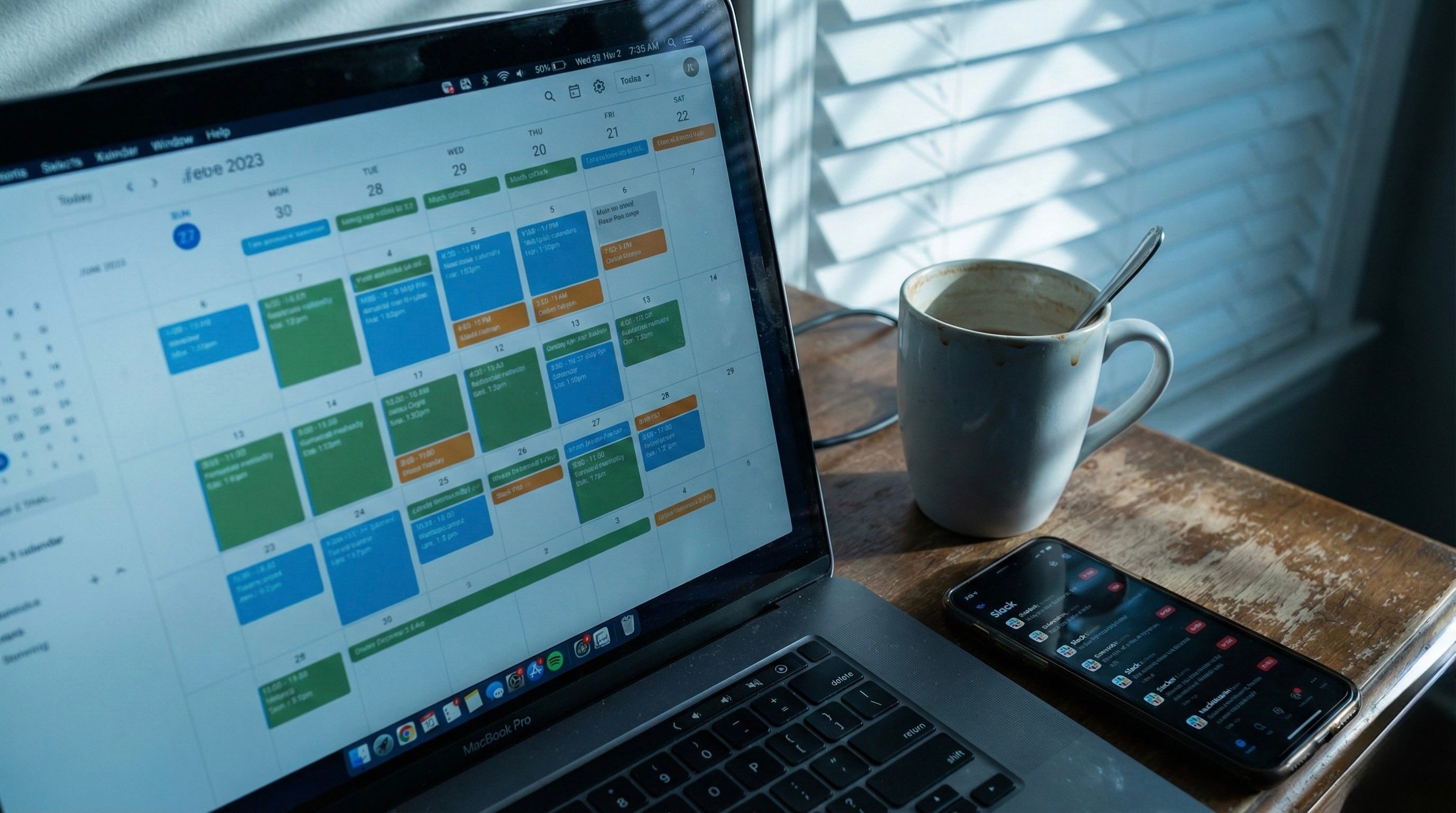
The Slack notification lands at 7:14 AM. Before coffee. Before thought.
By 7:30, you’ve triaged four threads, approved a PR you didn’t read carefully, and added three items to a list you won’t finish. Your calendar is a wall of color: nine meetings, no gaps, lunch blocked for a “quick sync” that will be neither.
This is the sound of a team running too fast. Not the sound of productivity. The sound of motion without direction.
Somewhere in the last decade, urgency became the default setting. The always-on channel. The same-day turnaround. The meeting that could have been a document but wasn’t, because documents require thinking and thinking requires time and time is the one thing no one has.
Here is the question no one asks: who decided this was the right tempo?
The Metronome Problem
In music production, tempo is not a feeling. It is a decision. You set the BPM before the first note. Too fast, and the performance sounds rushed, anxious, amateur. Too slow, and it drags. The right tempo creates space for dynamics: room to breathe, room to land, room for the listener to feel something.
Leadership teams have tempo too. But most have never consciously set it.
Instead, they inherit tempo from the environment. From the funding cycle. From the competitor who just shipped. From the exec who answers Slack at midnight and creates an unspoken expectation that everyone else should too.
This inherited tempo becomes invisible. It becomes “how we work here.” And because no one chose it, no one questions it.
The metronome keeps ticking. The team keeps moving. And the question of whether this is the right pace for this problem, at this moment, in this context, never gets asked.
Two Tempos
There are two failure modes. Most teams only recognize one.
The Stall. This is the obvious one. The team that moves too slowly. Endless discussion, no decision. Consensus paralysis. The startup that spends six months debating a feature while the market moves on. Leaders know this failure mode. They fear it. They overcorrect.
The Spin. This is the one hiding in plain sight. The team that moves so fast it never gains traction. Decisions get made, but they don’t stick. Priorities shift weekly. The roadmap is a living document, which sounds agile but actually means no one knows what matters. The team is busy. Exhausted. And somehow, nothing significant ships.
The Spin feels like progress. It generates activity metrics. It fills status reports. But it’s motion without momentum.
Here is the paradox: teams in The Spin often believe they’re moving too slowly. They feel behind. They push harder. They add more meetings, more check-ins, more urgency. And they accelerate further into dysfunction.
The problem isn’t effort. The problem is tempo.
What Fast Actually Costs
Speed has a price. The price is depth.
When you move fast, you make shallow decisions. You optimize for what can be answered quickly, not what matters most. You skip the second-order question. You take the meeting because declining requires an explanation, and explanations take time.
Fast teams tend to converge on the first reasonable answer, not the best answer. They lose the dissenting voice: the person who needs ten seconds of silence to formulate a thought never gets the opening. They optimize for confidence over accuracy, because confidence ships and doubt deliberates.
And fast becomes self-reinforcing. Once a team is running at high tempo, slowing down feels like falling behind. The calendar is full. The backlog is long. There’s always a reason why this week isn’t the week to pause.
So the tempo ratchets up. And the cost compounds: burnout, turnover, technical debt, strategic drift. The cost of speed is rarely visible on the dashboard. It shows up later, in the things that didn’t get built, the people who left, the decisions that now need to be undone.
Tempo as Leadership Choice
If tempo is a decision, someone has to make it.
This is a leadership job. Not because leaders are smarter, but because leaders control the calendar, the meeting cadence, the response-time expectations, the implicit signals about what “working hard” looks like.
When a VP responds to every message within minutes, they are setting tempo. When a CEO schedules back-to-back meetings with no buffer, they are setting tempo. When a manager praises the team for “moving fast” without asking what got sacrificed, they are setting tempo.
The team will match the leader’s pace. Not because they want to. Because the system incentivizes it.
Changing tempo requires deliberate action. It requires the leader who looks at the calendar and cancels the meeting that doesn’t need to happen. Who replies to Slack with “I’ll think about this and respond tomorrow.” Who asks, before the sprint starts, “Is this the right pace for this problem?”
These are small acts. They feel almost trivial. But they are the metronome clicks that set the rhythm for everyone else.

The Calibration Question
Most teams that feel behind are not actually behind. They are uncalibrated.
They are moving at a tempo that was never chosen, toward goals that were never clarified, with an urgency that was inherited from a context that no longer applies.
The fix is not to work harder. The fix is to stop, briefly, and ask: what tempo does this work actually require? Not what tempo does the market seem to demand. Not what tempo makes us feel productive. What tempo serves the outcome?
Sometimes the answer is fast. Some problems reward speed. But the speed should be chosen, not defaulted to.
The question to sit with: when was the last time your team consciously decided how fast to move?
If you can’t remember, the metronome is running you.
We are not behind. We are uncalibrated.
Resources & Further Reading
Foundational
Leadership That Gets Results — Daniel Goleman, Harvard Business Review (2000) Goleman’s research on six leadership styles, including pacesetting. His data shows that pacesetting, when overused, “may hurt your business in the long run” by overwhelming employees with demands for excellence.
Thinking, Fast and Slow — Daniel Kahneman (Farrar, Straus and Giroux, 2011) The foundational work on System 1 (fast, intuitive) vs System 2 (slow, deliberate) thinking. Essential for understanding why fast decisions tend toward the first reasonable answer, not the best one.
On Organizational Tempo
The Acceleration Trap — Heike Bruch & Jochen I. Menges, Harvard Business Review (April 2010) Research on what happens when organizations make exceptional bursts of speed into chronic overloading. The frenetic pace saps motivation, scatters focus, and confuses customers. Directly relevant to “The Spin.”
Slow Productivity: The Lost Art of Accomplishment Without Burnout — Cal Newport (Portfolio, 2024) Newport argues that digital office technologies introduced unsustainable overload. His three principles (do fewer things, work at a natural pace, obsess over quality) offer a practical counter to urgency culture.
Practical
Deep Work: Rules for Focused Success in a Distracted World — Cal Newport (Grand Central, 2016) The case for sustained, uninterrupted concentration. Newport’s argument that depth requires time directly supports the article’s claim that speed costs depth.
Previously in First Order
The Cost of Silence in Leadership Teams (2026-02-10) The predecessor to this article. Silence distorts what can be said; tempo distorts how fast decisions must be made. Both are system-level dysfunctions that compound.