

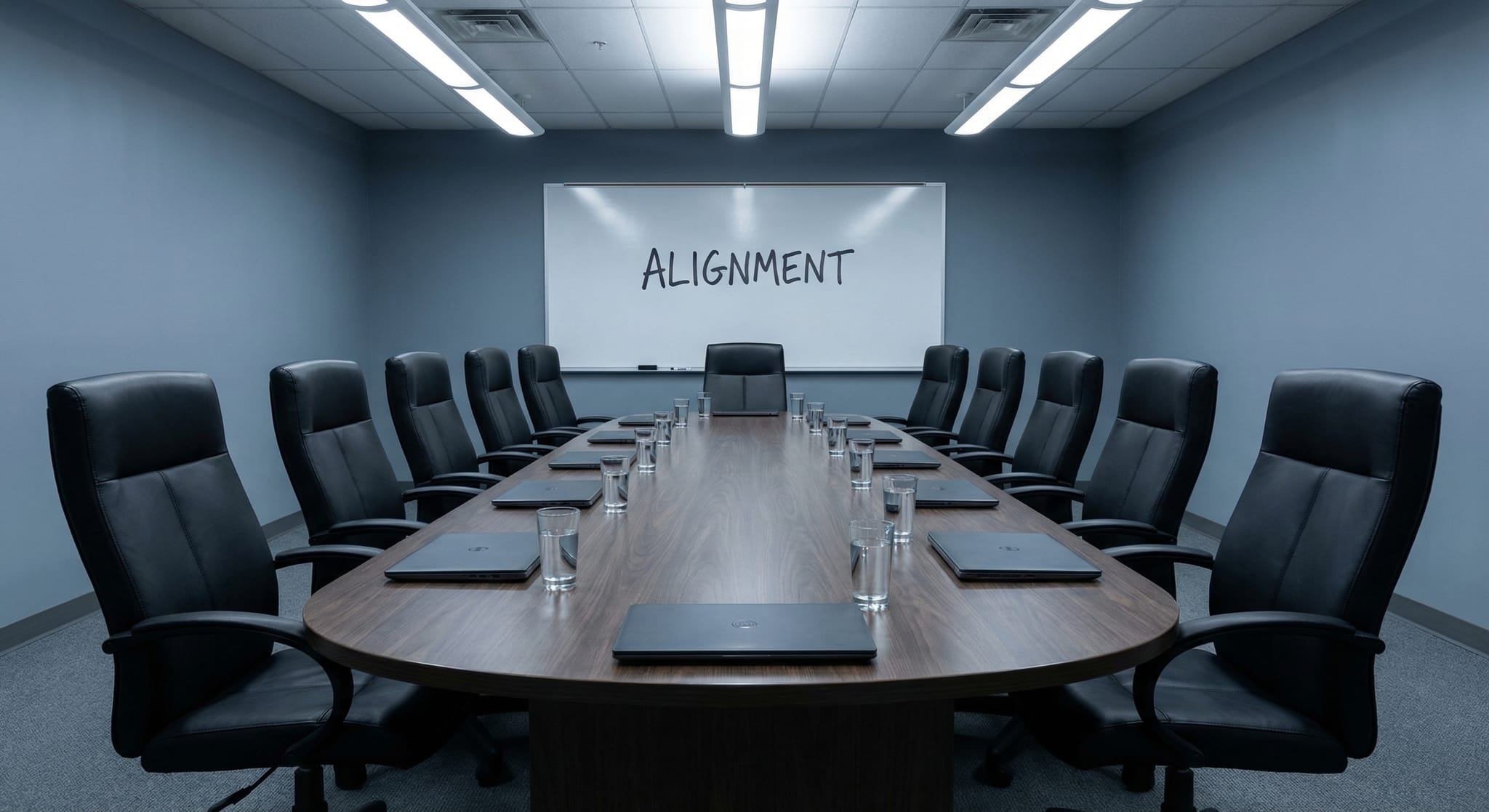
The week started with a sync. Then a check-in. Then an alignment meeting, which was different from the sync in name only. There was a stakeholder update Wednesday, a retrospective Thursday, and a planning session Friday that mostly revisited what the stakeholder update had already covered.
At no point did any of these meetings change a decision.
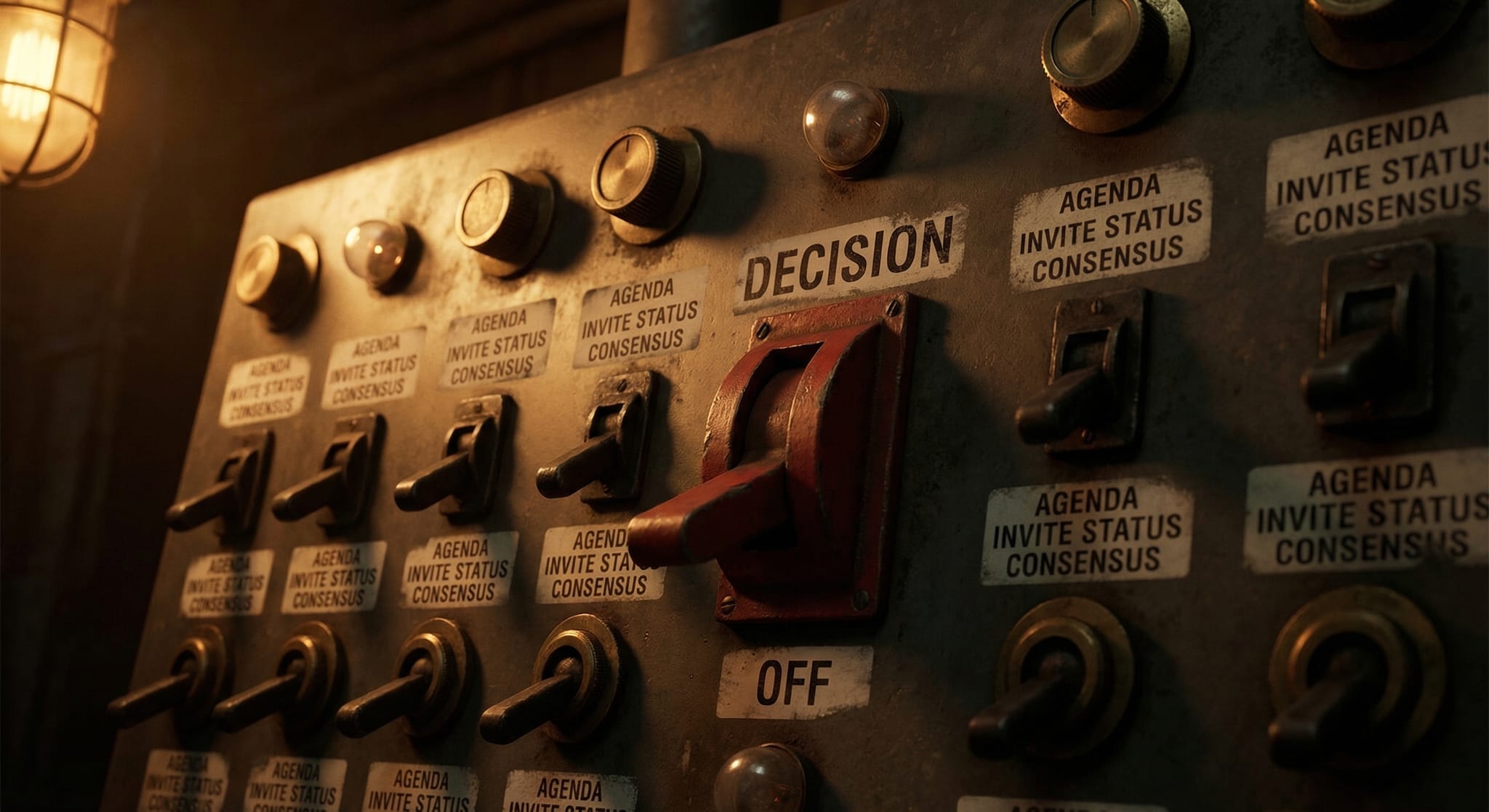
The decisions had already been made. Someone with authority made them, in private, before the calendar invites went out. The meetings were documentation: proof that the affected parties had been included. Not a forum. A receipt.
This is meetings as control: not a place where decisions happen, but a ritual that launders decisions into consensus. The difference matters more than most organizations are willing to admit.
The Three Failure Modes
Meetings fail in recognizable patterns. Naming them is the precondition for doing anything about them.
The Alignment Theater. The decision is final. The meeting exists to generate buy-in. Questions are welcomed as long as they don’t reopen the decision. Concerns get acknowledged. They do not get addressed. The facilitator says “good point” and moves to the next slide. Everyone leaves knowing the outcome was predetermined. Nobody says it out loud.
The Status Trap. Information flows in one direction: upward. Someone reports on a thing. Someone else reports on a different thing. Nothing in the room connects. No decision is possible because no decision is at stake. The meeting functions as a monitoring mechanism: leadership knows what everyone is working on; no one else learns anything. Forty-five minutes of reporting, fifteen minutes of follow-up questions that could have been an email.
The Consensus Mirage. A real decision needs to be made. The room contains people with conflicting interests. The meeting runs until conflict is exhausted rather than resolved. Someone concedes. Someone agrees to “take it offline.” A decision is recorded that no one actually made. Three weeks later, the same conflict surfaces in a different meeting, slightly reframed.
All three share a structural property: the meeting changes nothing. It manages appearances.
This is the same logic behind most RTO mandates. "We need everyone in the office for collaboration" is the agenda that says alignment. The decision was made before the announcement. What the mandate controls is not collaboration: it is visibility. Someone needs to see people at desks. The office is a meeting room that lasts eight hours.
I looked at the urban planning side of this in The Ghost in the 15-Minute City on Morphic. The organizational mechanism is the same.
This Is Not a Scheduling Problem
Productivity culture treats the meeting problem as a calendar problem. Too many meetings. Not enough focus time. Add blocks; protect mornings; decline more. This is a real problem. It is not the deeper one.
The harder issue: meetings have become the medium through which authority is exercised without accountability. A decision made in private is one someone owns. A decision made in a meeting is diffuse: everyone was there, everyone had input, the room reached consensus. The accountability dissolves into the calendar.
Leaders who run meeting-heavy organizations are not always disorganized. Many are quite deliberate. The meetings are doing exactly what they are designed to do: distributing ownership without distributing authority.
When you understand that, you understand why fewer meetings alone does not fix it. You need different meetings: ones that actually make decisions and make clear who made them.
The Protocol
Three questions. Before every meeting.
One: What decision is this meeting making? Not discussing. Not reviewing. Making. If no one can answer with a complete sentence, cancel the meeting. Send a written update. The decision does not require a room.
Two: Who has the authority to make that decision? Name them. Not the team. A person. If they are not in the room, there is no meeting: there is a briefing in disguise. Reschedule when the decision-maker is present, or acknowledge that no decision will come out of this and stop calling it one.
Three: What will be different after this meeting that could not have happened without it? This is the hardest question because it forces specificity. “We will be aligned” is not an answer. “The Q3 roadmap will have a signed-off P1 list by the time we leave the room” is an answer. If you cannot answer question three, questions one and two are moot.
Apply these three questions to your next calendar week. Most people cancel between a third and a half of what is on it.
Scripts
For when someone schedules an alignment theater meeting:
“What decision are we making in this one? If it is already made, can I get a summary instead so we can protect everyone’s time?”
For when a meeting has stalled:
“We have been in this conversation for twenty minutes and it is not resolving. Who has the authority to make this call? Let us get them on the line or reschedule when they are available.”
For when someone asks you to join a meeting “just to stay looped in”:
“What would you need from me there that you could not get from a five-minute update after? I want to be useful, not just present.”
These will feel awkward the first time. They are supposed to. The awkwardness is the signal that the norm you are disrupting was doing work for someone: absorbing accountability, diffusing conflict, creating the appearance of inclusion without the substance of it.
That discomfort is not a reason to stay quiet. It is information.
One Ask
Look at next week’s calendar before Monday arrives.
For each meeting: can something change based on what happens in that room? If yes, who has the authority to change it, and are they there? If no, ask what function the meeting is actually serving, and whether it is worth the cost to everyone on that invite.
Most meetings are not worth the cost. Not because the people running them are wrong. Because the structure prevents the outcome anyone actually needs.
If a meeting can’t change a decision, cancel it.
Previously: Narrative Laundering: When Words Replace Reality
Resources
The Effective Executive — Peter Drucker, 1967. Drucker’s foundational argument that meetings are a symptom of organizational dysfunction when they consume more than a quarter of an executive’s time. Written sixty years ago. Still accurate.
Thinking in Systems — Donella Meadows, Chelsea Green Publishing. The lens for understanding why structural fixes outlast behavioral ones. A meeting culture is a system: it will reassert itself unless the underlying incentives change.
Stop the Meeting Madness. Harvard Business Review — Perlow, L., Hadley, C., & Eun, E. (2017). , 95(4), 62–69. Data-backed study on how meeting overload cascades through organizations and the specific interventions that have actually worked. The researchers found most teams cut 20% of meeting time in four weeks when given simple decision-making protocols.